
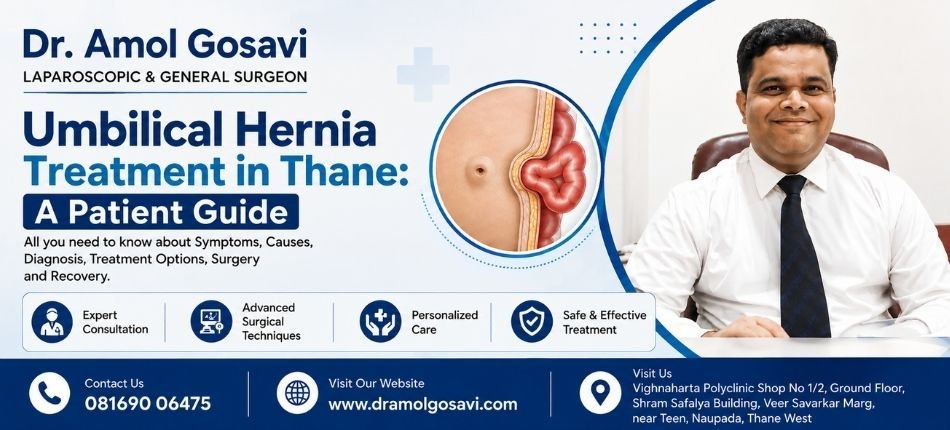
Umbilical Hernia Treatment in Thane: A Patient Guide – Dr. Amol Gosavi
An umbilical hernia is a condition in which tissue or a portion of the intestine pushes through a weak area of the abdominal wall near the belly button. In adults, an umbilical hernia may gradually increase in size and can sometimes cause pain or discomfort during routine activities.
If you have noticed a bulge around your navel, understanding the condition and getting an appropriate medical evaluation can help you make informed decisions about treatment. This patient guide explains the symptoms, causes, diagnosis, and options for Umbilical Hernia Treatment in Thane.
What Is an Umbilical Hernia?
The abdominal wall consists of layers of muscle and tissue that help keep the internal organs in position. When a weak area develops near the belly button, abdominal tissue or intestine may protrude through it, resulting in an umbilical hernia.
The swelling may become more noticeable while coughing, sneezing, lifting a heavy object, or straining. Some patients experience little discomfort initially, while others may develop pain or tenderness around the affected area.
What Causes an Umbilical Hernia in Adults?
In adults, an umbilical hernia can develop when increased pressure inside the abdomen acts on an already weakened area of the abdominal wall.
Factors that may contribute include:
- Being overweight or obese
- Repeated heavy lifting or straining
- Chronic coughing
- Multiple pregnancies
- Fluid accumulation within the abdomen
- Previous abdominal surgery
- Age-related weakening of abdominal muscles
Not every person with these factors will develop a hernia. A medical examination is important to determine the exact cause of a swelling or bulge near the navel.
Common Symptoms of an Umbilical Hernia
The most common symptom of an umbilical hernia is a noticeable bulge or swelling near the belly button. This bulge may become more prominent while coughing, sneezing, standing, lifting heavy objects, exercising, or straining. Some people may experience mild pain, tenderness, pressure, or discomfort around the navel, particularly during physical activity. Over time, the swelling may increase in size or become more uncomfortable. If the hernia suddenly becomes very painful, firm, tender, cannot be pushed back in, or is accompanied by nausea or vomiting, prompt medical evaluation is important because these symptoms may indicate a complication.
When Should You Consult a Doctor?
You should consider a medical consultation if you notice a new lump or swelling around the belly button, particularly if it is increasing in size or causing discomfort.
Seek urgent medical attention if the hernia becomes suddenly very painful, firm or extremely tender, cannot be pushed back in when it previously could, or is associated with vomiting or other significant symptoms. These features may indicate a complication that requires prompt assessment.
How Is an Umbilical Hernia Diagnosed?
Diagnosis usually begins with a clinical examination. The doctor examines the abdomen and evaluates the location, size, tenderness, and characteristics of the hernia.
You may be asked to stand, cough, or strain gently so that the hernia becomes easier to assess. In some situations, imaging such as an ultrasound or CT scan may be recommended to obtain additional information about the abdominal wall and the contents of the hernia.
The investigations required depend on the individual patient’s symptoms and clinical findings.
Does Every Umbilical Hernia Require Surgery?
Treatment decisions depend on several factors, including:
- Size of the hernia
- Presence and severity of symptoms
- Whether the hernia is increasing in size
- Whether it can be reduced
- Overall health of the patient
- Risk of complications
Unlike many childhood umbilical hernias, adult umbilical hernias generally do not close spontaneously. A surgeon can assess whether observation or surgical repair is appropriate in an individual case.
Umbilical Hernia Treatment in Thane
For patients looking for Umbilical Hernia Treatment in Thane, the first step is a detailed surgical consultation. Treatment is planned after evaluating the size and nature of the hernia, symptoms, general health, and other relevant medical factors.
When surgery is advised, the objective is to return the protruding tissue to its appropriate position and repair the weakness or defect in the abdominal wall.
Depending on the case, surgical options may include open or minimally invasive approaches.
Open Umbilical Hernia Repair
In open hernia surgery, an incision is made near the affected area. The protruding tissue is managed appropriately and the abdominal wall defect is repaired.
In suitable cases, a surgical mesh may be used to reinforce the weakened area. Whether mesh is required depends on factors such as the size of the defect and the patient’s individual circumstances.
Laparoscopic or Minimally Invasive Hernia Surgery
In selected patients, minimally invasive surgery may be considered. This technique generally involves making small incisions through which a camera and specialized surgical instruments are introduced.
The suitability of laparoscopic or another minimally invasive approach depends on the characteristics of the hernia, previous operations, general health, and the surgeon’s assessment.
There is no single surgical technique that is best for every patient. The appropriate method should be decided after an individual evaluation.
What Happens After Umbilical Hernia Surgery?
After umbilical hernia surgery, patients are generally encouraged to gradually resume light movement according to their surgeon’s advice. Some pain, swelling, or discomfort around the surgical area can occur during the initial recovery period and is usually managed as advised by the treating doctor. Patients receive instructions regarding wound care, medications, bathing, diet, walking, driving, returning to work, and physical activity. Heavy lifting and strenuous exercise may need to be avoided until the abdominal wall has adequately healed and the surgeon considers it safe. Recovery time varies depending on the size of the hernia, surgical technique, overall health, and type of work the patient performs, making follow-up appointments important for monitoring healing and planning a safe return to normal activities.
Why Early Evaluation Matters
An umbilical hernia may initially seem like a minor swelling, especially when it is painless. However, adult hernias can change over time.
Early evaluation does not necessarily mean immediate surgery. It allows the doctor to determine the nature of the swelling, assess the hernia, discuss potential risks, and recommend an appropriate management plan.
Consult Dr. Amol Gosavi for Umbilical Hernia Treatment in Thane
If you have noticed a bulge near your belly button or are experiencing symptoms suggestive of an umbilical hernia, consider seeking a surgical evaluation.
Dr. Amol Gosavi provides consultation for Umbilical Hernia Treatment in Thane, with treatment recommendations based on the patient’s symptoms, examination, and individual clinical needs.
Umbilical Hernia Treatment in Thane Umbilical Hernia Treatment in Thane Umbilical Hernia Treatment in Thane Umbilical Hernia Treatment in Thane Umbilical Hernia Treatment in Thane Umbilical Hernia Treatment in Thane Umbilical Hernia Treatment in Thane Umbilical Hernia Treatment in Thane
