
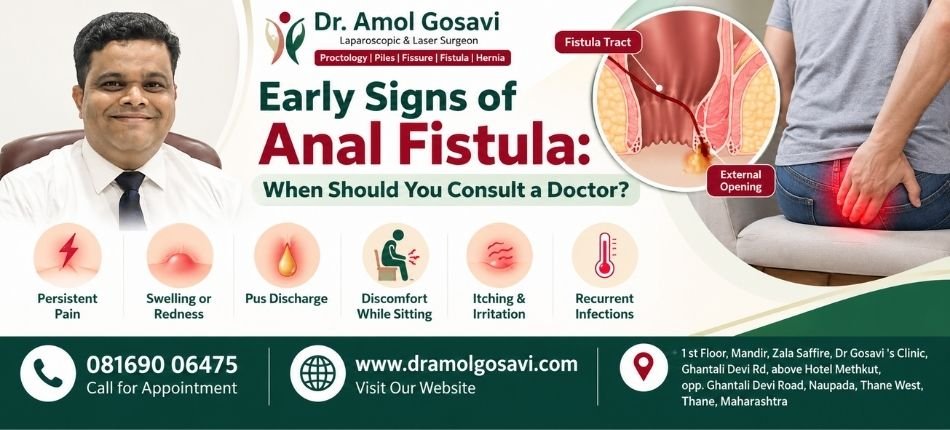
Early Signs of Anal Fistula: When Should You Consult a Doctor? – Dr. Amol Gosavi
Introduction
Anal Fistula Symptoms in Thane are important to recognize early, especially if you experience persistent pain, swelling, repeated infections, or unusual discharge near the anus. An anal fistula is an abnormal tunnel that develops between the anal canal and the skin surrounding the anus, often following an infection in the anal glands. Although the symptoms may initially appear similar to piles or an anal fissure, an anal fistula is a different condition that usually requires medical evaluation and often procedural or surgical treatment.
Many people ignore early warning signs because they feel embarrassed discussing anorectal problems or assume the discomfort will disappear on its own. However, recurring swelling, pus discharge, and persistent pain may indicate an underlying infection or fistula that requires attention.
At Dr. Amol Gosavi’s Clinic in Naupada, Thane West, patients can seek consultation for anorectal conditions, including anal fistula, piles, and fissures. Understanding the causes, symptoms, diagnosis, and available treatment options can help patients make informed decisions about their health.
This detailed guide explains the early signs of anal fistula, when to consult a doctor, and how the condition is diagnosed and managed.
1. What Is an Anal Fistula?
An anal fistula, medically known as fistula-in-ano, is an abnormal passage or tunnel that connects the inside of the anal canal to an opening in the skin near the anus.
The condition commonly develops after an anal gland becomes infected, resulting in an abscess. When the abscess drains, a tunnel may remain between the anal canal and the skin.
This tunnel can allow pus or other fluid to drain intermittently, leading to repeated discomfort, swelling, and irritation.
Anal fistulas rarely heal permanently without appropriate medical treatment because the abnormal tract often remains present even after the initial infection improves.
The complexity of a fistula depends on its location, branching pattern, and relationship with the anal sphincter muscles.
Early medical assessment helps determine the type of fistula and the most suitable treatment approach.
2. What Causes an Anal Fistula?
Understanding the causes of anal fistula can help patients recognize why symptoms develop and why repeated infections may occur.
Anal Abscess
The most common cause of an anal fistula is a previous anal abscess.
An abscess develops when an anal gland becomes infected and pus collects in the surrounding tissues. Even after the abscess drains or is treated, an abnormal passage may remain.
Infection of Anal Glands
Small glands located inside the anal canal can become blocked and infected.
The infection may spread into nearby tissues and eventually create a fistula tract.
Crohn’s Disease
Crohn’s disease is a chronic inflammatory bowel condition that can affect different parts of the digestive tract.
Some patients with Crohn’s disease develop complex or recurrent anal fistulas due to ongoing inflammation.
Previous Surgery or Injury
Less commonly, anal fistulas may develop following trauma, surgery, or injury involving the anal region.
Other Medical Conditions
Certain infections and inflammatory conditions may also contribute to fistula formation.
However, not every case has an obvious underlying cause.
3. Early Signs and Symptoms of Anal Fistula
Recognizing Anal Fistula Symptoms in Thane can help patients seek medical attention before repeated infections or complications develop.
3.1 Persistent Pain Near the Anus
One of the common early symptoms of an anal fistula is persistent discomfort or pain around the anal opening. The pain may feel dull, throbbing, or sharp and can become more noticeable while sitting, walking, coughing, or passing stools. Some patients experience intermittent discomfort, particularly when swelling develops around the fistula opening. Pain may temporarily improve when pus drains, but it can return if the opening becomes blocked or another infection develops. Persistent anal pain should be evaluated rather than automatically attributed to piles.
3.2 Swelling or Redness Around the Anal Area
Swelling, redness, or tenderness near the anus may indicate inflammation or infection associated with a fistula. Patients may notice a small lump or painful raised area close to the anal opening. The swelling can increase when fluid accumulates inside the tract and may reduce after drainage occurs. Repeated episodes of swelling in the same location are an important warning sign. A doctor can examine the area to determine whether the symptoms are related to an abscess, fistula, or another anorectal condition.
3.3 Repeated Pus or Fluid Discharge
Persistent or recurring discharge is one of the characteristic signs of an anal fistula. Patients may notice yellowish pus, blood-stained fluid, or unpleasant-smelling discharge from a small opening near the anus. This discharge can stain underwear and cause discomfort throughout the day. The amount of drainage may vary depending on whether the fistula tract is open or temporarily blocked. Even when the discharge decreases, the underlying fistula may still be present. Repeated drainage requires medical evaluation.
3.4 Skin Irritation and Itching
Continuous moisture or discharge around the anal region can irritate the surrounding skin. Patients may experience itching, redness, soreness, or a burning sensation, particularly after prolonged sitting or physical activity. Frequent wiping may worsen irritation and make the skin more sensitive. Although itching can occur with several anorectal conditions, irritation accompanied by recurring discharge or swelling may suggest a fistula. Maintaining gentle hygiene can reduce discomfort, but it does not eliminate the underlying fistula tract.
3.5 Recurring Anal Abscesses
Repeated development of a painful lump or abscess near the anus can indicate an underlying fistula. An abscess may cause swelling, tenderness, and pus accumulation, sometimes followed by spontaneous drainage. If the infection repeatedly returns to the same area, an abnormal tunnel may be allowing bacteria to enter surrounding tissues. Recurring abscesses should not be ignored because they may require drainage and further investigation to identify a fistula.
3.6 Fever and General Discomfort
Some patients develop fever, chills, fatigue, or general weakness when an active infection or abscess is present. These symptoms may occur alongside increasing anal pain, swelling, and tenderness. Fever is not present in every anal fistula case, but it can indicate a more significant infection requiring prompt medical assessment. High fever, rapidly worsening pain, spreading redness, or feeling seriously unwell should be treated as urgent warning signs.
4. Anal Fistula vs Piles vs Anal Fissure: Understanding the Difference
Anal fistula, piles, and anal fissure are different anorectal conditions, although some symptoms may overlap.
| Condition | Main Problem | Common Symptoms |
|---|---|---|
| Anal Fistula | Abnormal tunnel between the anal canal and surrounding skin | Recurrent discharge, swelling, pain, repeated abscesses |
| Piles (Hemorrhoids) | Swollen blood vessels in or around the anus | Bleeding, itching, swelling, discomfort |
| Anal Fissure | Small tear in the lining of the anal canal | Sharp pain during bowel movements, bright red bleeding |
| Anal Abscess | Localized collection of pus caused by infection | Severe pain, swelling, tenderness, sometimes fever |
A fistula often produces repeated discharge or infections, while an anal fissure commonly causes sharp pain during bowel movements.
Piles may cause bleeding or swelling but do not usually produce pus discharge.
Because symptoms can overlap, a professional examination is necessary for an accurate diagnosis.
5. When Should You Consult a Doctor for Anal Fistula Symptoms?
Many patients delay medical consultation because anal symptoms can be uncomfortable or embarrassing to discuss. However, persistent or recurring symptoms should not be ignored. If you notice repeated pus discharge, swelling near the anus, recurring painful lumps, or discomfort that does not improve, consulting a qualified doctor is important. These symptoms may indicate an anal fistula, an abscess, or another condition that requires specific treatment. Early assessment helps identify the cause and determine whether medication, drainage, or a procedure is necessary.
You should also seek medical attention if anal pain interferes with sitting, walking, sleeping, or daily activities. Symptoms such as fever, increasing swelling, spreading redness, or worsening pain may indicate an active infection and require urgent evaluation. Patients with diabetes, weakened immunity, or inflammatory bowel disease should be particularly cautious about persistent anorectal infections. At Dr. Amol Gosavi’s Clinic in Thane West, patients can enquire about evaluation of anorectal symptoms and appropriate treatment options.
6. How Is an Anal Fistula Diagnosed?
Accurate diagnosis is essential because fistulas differ in location, depth, complexity, and involvement of the anal sphincter muscles.
Medical History
The doctor may ask about previous anal abscesses, recurring discharge, pain, bowel habits, medical conditions, and previous anorectal procedures.
Physical Examination
The area surrounding the anus is examined for external openings, swelling, redness, scars, or discharge.
A gentle examination may help identify signs of an underlying fistula.
Digital Rectal Examination
When appropriate and tolerable, a digital rectal examination may help assess the anal canal and surrounding structures.
Proctoscopy or Anoscopy
A doctor may recommend an examination of the anal canal to identify internal abnormalities or a possible fistula opening.
MRI Fistulography
MRI is particularly useful in complex, recurrent, or unclear cases because it can help identify fistula tracts, branches, abscesses, and their relationship to the sphincter muscles.
Endoanal Ultrasound
In selected cases, endoanal ultrasound may help evaluate the fistula tract and nearby anatomical structures.
Not every patient requires every investigation. The diagnostic approach depends on clinical findings and suspected fistula complexity.
7. Types of Anal Fistula
Anal fistulas are commonly classified according to their relationship with the anal sphincter muscles.
Intersphincteric Fistula
The tract passes between the internal and external anal sphincter muscles.
Transsphincteric Fistula
The fistula passes through part of the external anal sphincter.
Suprasphincteric Fistula
The tract travels above the puborectalis muscle before extending toward the skin.
Extrasphincteric Fistula
This is a less common type in which the tract extends from the rectum to the skin without following the usual anal gland pathway.
Fistulas may also be described as simple or complex based on factors such as sphincter involvement, branching, recurrence, and associated medical conditions.
Correct classification is important because treatment must balance fistula healing with preservation of bowel control.
8. Can an Anal Fistula Heal Without Surgery?
Many patients hope that an anal fistula will disappear with medicines, creams, or home remedies.
However, most anal fistulas do not heal permanently without an appropriate procedure or surgery.
Antibiotics may be prescribed for selected infections, but they generally cannot eliminate an established fistula tract by themselves.
Similarly, pain-relieving medicines and warm sitz baths may reduce discomfort without curing the underlying condition.
Treatment depends on the fistula type, presence of infection, sphincter involvement, and associated conditions.
Some patients with Crohn’s-related fistulas may require specialized medical treatment alongside surgical management.
A qualified doctor can explain the available options after assessing the fistula.
9. Treatment Options for Anal Fistula
Treatment aims to eliminate or control the fistula tract, manage infection, encourage healing, and preserve anal sphincter function.
9.1 Fistulotomy
Fistulotomy involves opening the fistula tract so that it can heal from the inside outward.
It may be suitable for selected simple fistulas involving little or no sphincter muscle.
The procedure is not appropriate for every fistula because dividing too much sphincter muscle can affect bowel control.
9.2 Seton Placement
A seton is a surgical thread or loop placed through the fistula tract.
It may be used to maintain drainage, manage infection, or support staged treatment of more complex fistulas.
The role and duration of a seton depend on the treatment plan.
9.3 LIFT Procedure
LIFT stands for Ligation of the Intersphincteric Fistula Tract.
This procedure is designed to treat selected fistulas while minimizing damage to the anal sphincter muscles.
Suitability depends on fistula anatomy and clinical findings.
9.4 Advancement Flap Procedure
An advancement flap procedure involves covering the internal fistula opening using nearby healthy tissue.
It may be considered for selected complex fistulas where sphincter preservation is particularly important.
9.5 Laser Treatment for Anal Fistula
Laser-assisted fistula treatment uses specialized laser energy within the fistula tract.
It may be considered in selected cases as a sphincter-preserving approach.
However, laser treatment is not suitable for every fistula, and recurrence can occur. Evidence on long-term effectiveness varies, so patients should discuss expected benefits, limitations, alternatives, and costs with their treating surgeon.
9.6 Treatment of Anal Abscess
If an abscess is present, prompt drainage is often necessary.
Treating the infection is an important part of care, but additional fistula treatment may still be required.
Important: No single procedure is best for every patient. The appropriate treatment depends on fistula complexity, sphincter involvement, medical history, and the surgeon’s assessment.
10. Is Laser Treatment Better Than Traditional Anal Fistula Surgery?
Laser treatment is sometimes promoted as a minimally invasive option for anal fistula management.
For selected patients, laser-assisted procedures may involve limited tissue cutting and aim to preserve sphincter function.
However, treatment success varies, and the fistula may persist or recur.
Traditional procedures such as fistulotomy have established effectiveness for appropriately selected simple fistulas.
For complex fistulas, sphincter-preserving techniques such as LIFT, advancement flap procedures, or staged treatment may be considered.
The choice should be based on fistula anatomy, available evidence, the surgeon’s experience, and the patient’s priorities.
Patients should avoid assuming that laser treatment automatically provides faster healing, permanent cure, or a lower recurrence risk in every case.
11. What Happens If an Anal Fistula Is Left Untreated?
An untreated anal fistula may continue to cause repeated discharge, swelling, discomfort, and infections.
The fistula opening may temporarily close, allowing pus to accumulate and form another abscess.
Some fistulas may develop additional branches or become more difficult to manage over time.
Persistent drainage can also irritate the surrounding skin and interfere with daily activities.
Although serious complications are uncommon, recurrent infections and increasing fistula complexity can affect treatment planning.
For these reasons, persistent symptoms should be assessed rather than managed indefinitely with home remedies.
12. Recovery After Anal Fistula Treatment
Recovery depends on the type of fistula, treatment procedure, wound size, and individual health.
Initial Recovery
Patients may experience discomfort, mild drainage, and wound sensitivity following treatment.
Doctors may recommend pain management, wound care, and appropriate hygiene practices.
Wound Care
Keeping the area clean and following dressing instructions can support healing.
Warm sitz baths may be recommended in selected cases to improve comfort.
Bowel Management
Adequate hydration, dietary fiber, and prescribed stool-softening measures may help reduce straining during bowel movements.
Returning to Daily Activities
The timing of return to work, exercise, and other activities depends on the procedure and recovery progress.
Follow-Up Appointments
Follow-up examinations allow the treating doctor to assess wound healing and identify signs of persistent or recurrent fistula.
Patients should follow their surgeon’s instructions rather than relying on a fixed recovery timeline.
13. Diet and Lifestyle Tips During Anal Fistula Recovery
Maintaining a healthy diet and proper hygiene is important for supporting recovery after anal fistula treatment. Eating fiber-rich foods such as fruits, vegetables, and whole grains, along with drinking sufficient water, can help prevent constipation and reduce straining during bowel movements. Patients should keep the anal area clean, follow prescribed wound-care instructions, and avoid prolonged sitting if it causes discomfort. Gentle physical activity, adequate rest, and regular follow-up appointments can support the healing process. Following your doctor’s recommendations and reporting unusual pain, swelling, fever, or discharge promptly can help identify potential complications during recovery.
14. Can Anal Fistula Come Back After Treatment?
Yes, an anal fistula can recur after treatment.
The risk of recurrence depends on factors such as fistula complexity, branching tracts, underlying inflammatory conditions, previous procedures, and the treatment method used.
Complex or recurrent fistulas may require additional investigations and specialized management.
Persistent discharge, repeated swelling, or renewed pain after treatment should be reported to the treating doctor.
Regular follow-up helps assess healing and identify problems that may need further attention.
15. Anal Fistula Symptoms in Thane: Why Early Medical Consultation Matters
Patients experiencing recurring anal pain, pus discharge, swelling, or repeated abscesses should seek appropriate medical evaluation.
Recognizing Anal Fistula Symptoms in Thane and arranging timely consultation can help identify the underlying condition and prevent unnecessary delays in treatment.
Early diagnosis is especially important when symptoms suggest an active infection or a complex fistula.
A professional assessment can determine whether the condition requires abscess drainage, further imaging, or a fistula procedure.
For patients living in Thane West, Naupada, and nearby areas, consulting an appropriately qualified healthcare professional can help clarify the diagnosis and available treatment options.
16. Consultation for Anal Fistula at Dr. Amol Gosavi’s Clinic in Thane
Patients experiencing anal fistula symptoms can contact Dr. Amol Gosavi’s Clinic in Naupada, Thane West, to enquire about consultation and evaluation.
Anal fistula management requires an individualized approach because fistulas differ in their anatomy, severity, and relationship with the anal sphincter muscles.
A medical assessment may include symptom evaluation, physical examination, and investigations when necessary.
Treatment recommendations depend on the diagnosis, presence of infection, fistula complexity, and individual health requirements.
Patients seeking information about anorectal conditions can also visit the proctology treatment information page on Dr. Amol Gosavi’s website.
Conclusion
Anal fistula is an anorectal condition that can cause persistent discomfort, recurring infections, swelling, and pus discharge near the anus.
Recognizing early warning signs and seeking professional medical evaluation can help patients understand the condition and available treatment options.
Anal Fistula Symptoms in Thane, such as repeated abscesses, persistent anal pain, and recurring discharge, should not be ignored.
Although medicines and home-care measures may relieve certain symptoms, most established anal fistulas require an appropriate medical procedure or surgery for definitive treatment.
For consultation regarding anal fistula and other anorectal conditions, patients can contact Dr. Amol Gosavi’s Clinic in Thane West.
Contact Dr. Amol Gosavi
Dr. Amol Gosavi – Laparoscopic & Laser Surgeon, Proctology Consultation
Contact: 081690 06475
Website: www.dramolgosavi.com
Address: Dr. Gosavi’s Clinic, 1st Floor, Zala Saffire, Ghantali Devi Road, Above Hotel Methkut, Naupada, Thane West, Thane, Maharashtra.
Call 081690 06475 to enquire about an appointment.
Anal Fistula Symptoms in Thane Anal Fistula Symptoms in Thane Anal Fistula Symptoms in Thane Anal Fistula Symptoms in Thane Anal Fistula Symptoms in Thane Anal Fistula Symptoms in Thane Anal Fistula Symptoms in Thane Anal Fistula Symptoms in Thane Anal Fistula Symptoms in Thane Anal Fistula Symptoms in Thane Anal Fistula Symptoms in Thane Anal Fistula Symptoms in Thane Anal Fistula Symptoms in Thane Anal Fistula Symptoms in Thane Anal Fistula Symptoms in Thane Anal Fistula Symptoms in Thane Anal Fistula Symptoms in Thane Anal Fistula Symptoms in Thane Anal Fistula Symptoms in Thane Anal Fistula Symptoms in Thane Anal Fistula Symptoms in Thane Anal Fistula Symptoms in Thane Anal Fistula Symptoms in Thane Anal Fistula Symptoms in Thane Anal Fistula Symptoms in Thane Anal Fistula Symptoms in Thane Anal Fistula Symptoms in Thane
