
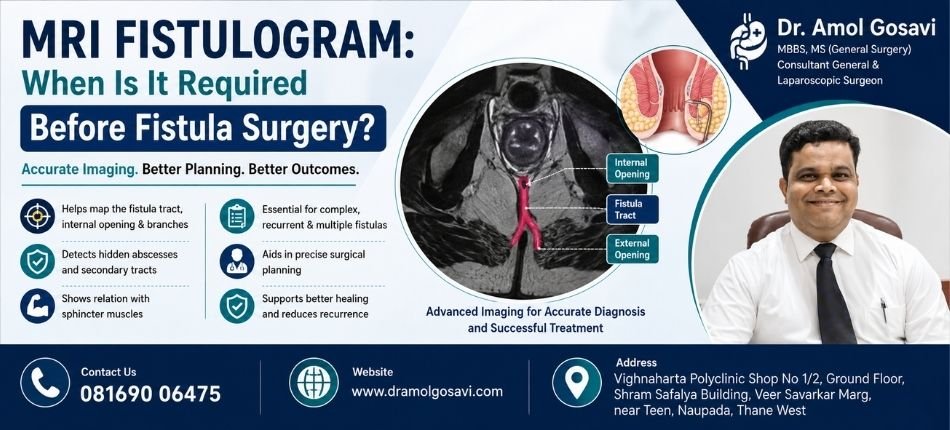
MRI Fistulogram: When Is It Required Before Fistula Surgery? | MRI Fistulogram Before Fistula Surgery – Dr. Amol Gosavi
Introduction
An anal fistula is an abnormal tunnel that develops between the anal canal and the skin around the anus. While some fistulas may have a relatively straightforward tract, others can have multiple branches, hidden extensions, abscesses, or a complex relationship with the muscles responsible for bowel control.
For this reason, understanding the exact anatomy of a fistula can be important before deciding on treatment. In selected patients, a doctor may recommend an MRI Fistulogram Before Fistula Surgery to obtain detailed information about the fistula tract and surrounding tissues.
MRI imaging can help the treating surgeon understand the location and complexity of the fistula and plan an appropriate treatment strategy. However, an MRI is not necessarily required for every patient. The decision depends on clinical examination, previous treatment history, and the suspected complexity of the fistula.
What Is an MRI Fistulogram?
An MRI fistulogram is a specialized magnetic resonance imaging study used to evaluate an anal fistula and the surrounding soft tissues.
It can provide detailed images showing the fistula tract, its internal and external openings, secondary branches, collections or abscesses, and its relationship with the anal sphincter muscles.
Unlike ordinary imaging methods, MRI provides detailed soft-tissue visualization. This can be particularly valuable when the fistula has a complicated pathway that cannot be completely understood through physical examination alone.
Why Is Accurate Fistula Mapping Important?
Accurate fistula mapping helps the surgeon understand the complete pathway of the fistula, including its internal opening, branches, and relationship with the anal sphincter muscles. It can also help identify hidden tracts or abscesses that may not be obvious during clinical examination. Detailed mapping is particularly important in complex or recurrent fistulas. This information supports better surgical planning while considering the protection of surrounding healthy tissues and sphincter function.
When Is an MRI Fistulogram Before Fistula Surgery Required?
Not every anal fistula requires MRI evaluation. In straightforward cases, clinical examination may provide sufficient information.
However, an MRI Fistulogram Before Fistula Surgery may be recommended in certain situations.
1. Complex Anal Fistula
Complex fistulas can have deeper tracts or involve a significant portion of the anal sphincter muscles. Understanding their precise course is important before planning surgery.
MRI can provide a detailed view of the fistula’s relationship with the surrounding muscles and tissues.
2. Recurrent Fistula
If a fistula returns after previous treatment, its anatomy may be more difficult to assess.
There may be scar tissue, residual fistula tracts, previously unidentified branches, or new extensions. MRI can help provide additional information before another procedure is considered.
3. Multiple Fistula Openings
Some patients may have more than one external opening or multiple interconnected fistula tracts.
An MRI can help determine whether these openings belong to a single branching fistula or represent separate pathways.
4. Suspected Abscess
A fistula may sometimes be associated with an abscess or collection of infected fluid.
Deep abscesses may not always be obvious from external examination. MRI can help identify such collections and show their location.
5. Hidden Secondary Branches
One reason for persistent or recurrent fistula problems can be an unrecognized secondary tract.
MRI provides detailed imaging that may reveal extensions that are difficult to identify during routine examination.
6. Unclear Fistula Anatomy
Sometimes the surgeon may not be able to determine the complete fistula pathway through examination alone.
In these situations, MRI can provide additional anatomical information that may assist with treatment planning.
Does Every Fistula Patient Need an MRI?
No, every fistula patient does not necessarily need an MRI. Simple fistulas may often be evaluated adequately through clinical examination and other appropriate assessments. An MRI fistulogram is more commonly considered for complex, recurrent, multiple, or difficult-to-map fistulas or when an abscess is suspected. The surgeon decides whether an MRI is required based on the patient’s symptoms, examination findings, previous treatment, and fistula complexity.
What Happens During an MRI Fistulogram?
MRI uses a strong magnetic field and radio waves to produce detailed images. It does not use ionizing radiation such as that used in X-rays.
During the examination, the patient generally lies on the MRI table while images of the pelvic and anal region are taken. The radiology team provides instructions regarding preparation and the procedure.
In some cases, contrast material may be used depending on the clinical requirement and imaging protocol.
Patients should inform the radiology team about implants, pacemakers, previous surgeries, pregnancy, kidney problems, or other relevant medical conditions before undergoing MRI.
How Does MRI Help in Fistula Surgery Planning?
The goal of imaging is not simply to confirm that a fistula exists. It can help provide a map of the disease.
The surgeon can use this information along with physical examination and other clinical findings to understand the fistula’s course and choose an appropriate treatment strategy.
This may be especially valuable when dealing with recurrent or complex fistulas where preserving sphincter function is an important consideration.
Can MRI Determine the Exact Fistula Treatment?
MRI provides useful anatomical information, but the scan alone does not determine the treatment.
The appropriate procedure depends on multiple factors, including the type of fistula, sphincter involvement, previous treatments, infection, symptoms, and the patient’s overall condition.
A surgeon evaluates the MRI findings together with clinical examination before recommending treatment.
Conclusion
An MRI Fistulogram Before Fistula Surgery can be an important diagnostic tool for selected patients, particularly when the fistula is complex, recurrent, associated with an abscess, or difficult to map clinically.
By providing detailed information about the fistula tract, secondary branches, collections, and surrounding muscles, MRI can assist the surgeon in understanding the condition before treatment.
However, not every fistula patient requires an MRI. The decision should be based on individual clinical findings and a surgeon’s assessment.
Dr. Amol Gosavi provides evaluation and surgical consultation for anal fistula and other gastrointestinal and anorectal conditions in Thane.
MRI Fistulogram Before Fistula Surgery MRI Fistulogram Before Fistula Surgery MRI Fistulogram Before Fistula Surgery MRI Fistulogram Before Fistula Surgery MRI Fistulogram Before Fistula Surgery MRI Fistulogram Before Fistula Surgery MRI Fistulogram Before Fistula Surgery MRI Fistulogram Before Fistula Surgery
