
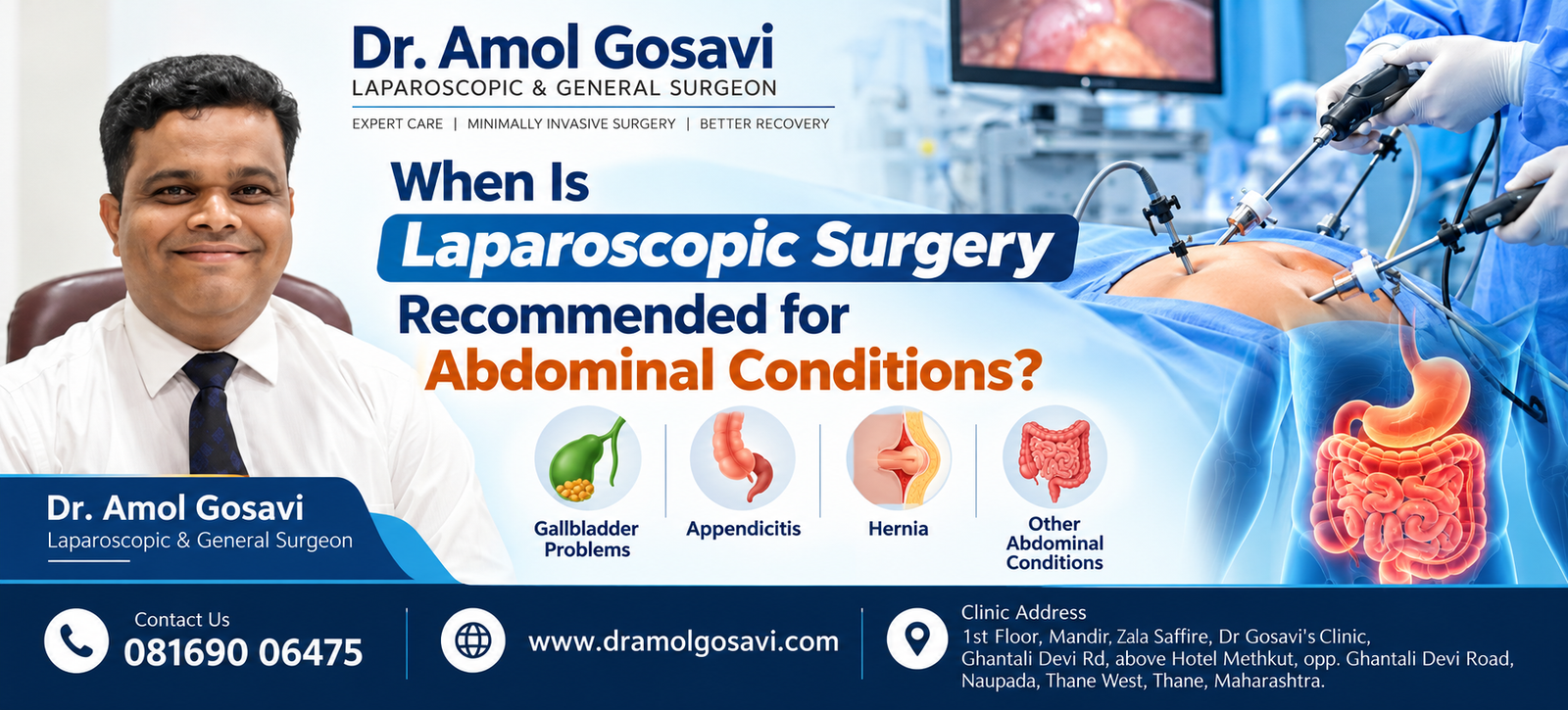
When Is Laparoscopic Surgery Recommended for Abdominal Conditions? – Dr. Amol Gosavi
Introduction
Patients considering Laparoscopic Abdominal Surgery in Thane can consult Dr. Amol Gosavi to understand minimally invasive treatment options for gallbladder problems, hernias, appendicitis, and other abdominal conditions.
Laparoscopic surgery, also called minimally invasive or keyhole surgery, allows surgeons to perform many abdominal procedures through small incisions using a specialized camera and instruments.
Patients exploring surgical treatment can consult Dr. Amol Gosavi, a laparoscopic surgeon in Thane, to discuss their symptoms, diagnostic findings, and suitable treatment options.
However, not every abdominal condition requires surgery, and laparoscopic surgery is not appropriate for every patient. The decision depends on the diagnosis, severity of symptoms, medical history, imaging results, and overall health.
This article explains when laparoscopic surgery may be recommended, which abdominal conditions can be treated, its potential benefits and risks, and what patients should expect before and after surgery.
1. What Is Laparoscopic Abdominal Surgery?
Laparoscopic Abdominal Surgery is a minimally invasive surgical technique used to diagnose or treat conditions affecting the abdomen and pelvis.
During the procedure, the surgeon makes small incisions in the abdominal wall and inserts a laparoscope, a thin instrument fitted with a camera and light source.
The camera displays images of the internal organs on a monitor, allowing the surgeon to perform the operation using specialized surgical instruments.
In many abdominal procedures, carbon dioxide gas is introduced into the abdomen to create space for the instruments.
Laparoscopic Abdominal Surgery is commonly performed under general anesthesia.
Compared with conventional open surgery, it may offer smaller incisions, reduced postoperative discomfort, shorter hospital stays, and faster recovery for appropriately selected patients.
2. When Is Laparoscopic Surgery Recommended for Abdominal Conditions?
Doctors may recommend Laparoscopic Abdominal Surgery when a diagnosed abdominal condition requires surgical treatment and a minimally invasive approach is considered appropriate.
The decision is based on several factors:
- The type and severity of the abdominal condition
- Persistent or recurring symptoms
- Findings from ultrasound, CT scans, or other investigations
- Whether medicines or other treatments are suitable
- Risk of complications without treatment
- Previous abdominal surgeries
- Overall health and anesthesia risks
For example, a patient experiencing repeated painful gallstone attacks may be advised to undergo gallbladder removal, while a patient with an uncomplicated, symptom-free gallstone may not require an operation.
Similarly, some hernias require surgical repair, while others may be monitored under medical supervision.
A detailed examination is necessary before deciding whether surgery is appropriate.
3. Abdominal Conditions That May Require Laparoscopic Surgery
3.1 Gallstones and Gallbladder Problems
Gallstones are hardened deposits that form inside the gallbladder. Many people with gallstones experience no symptoms, but others develop episodes of abdominal pain, nausea, vomiting, or inflammation.
Symptoms may include:
- Pain in the upper-right abdomen
- Discomfort after meals, particularly fatty meals
- Nausea or vomiting
- Pain spreading toward the back or right shoulder
- Recurrent episodes of abdominal discomfort
When gallstones cause repeated symptoms or complications, doctors may recommend laparoscopic cholecystectomy, which involves removing the gallbladder.
The procedure is commonly used for symptomatic gallstone disease.
However, gallstones that do not cause symptoms usually do not require immediate treatment.
Patients can explore information about laparoscopic gallbladder surgery in Thane and discuss treatment options during a surgical consultation.
3.2 Appendicitis
Appendicitis occurs when the appendix becomes inflamed. It often causes abdominal pain that may begin near the navel and move toward the lower-right abdomen.
Common symptoms include:
- Increasing abdominal pain
- Loss of appetite
- Nausea and vomiting
- Fever
- Tenderness in the lower-right abdomen
Appendicitis requires prompt medical evaluation because an untreated inflamed appendix may rupture and cause serious infection.
Laparoscopic appendectomy is a commonly used surgical approach for removing the appendix.
Some selected cases of uncomplicated appendicitis may be managed with antibiotics after specialist assessment, but surgery is often recommended, particularly when complications are present or nonoperative treatment is unsuitable.
The surgical approach depends on the patient’s condition and the extent of inflammation.
Important: Severe or worsening abdominal pain, especially with fever or vomiting, requires urgent medical assessment rather than waiting for a routine consultation.
3.3 Abdominal and Inguinal Hernias
A hernia develops when tissue or part of an internal organ pushes through a weakened area of the surrounding muscle or connective tissue.
Common abdominal hernias include:
- Inguinal hernia
- Umbilical hernia
- Incisional hernia
- Ventral hernia
A hernia may appear as a visible bulge and can cause discomfort while lifting, coughing, standing, or performing physical activities.
Laparoscopic hernia repair may be recommended when a hernia causes symptoms, increases in size, or presents a risk of complications.
During certain hernia repairs, a surgical mesh may be used to strengthen the weakened area.
However, not every hernia requires immediate surgery. Some minimally symptomatic hernias may be monitored after specialist evaluation.
The choice between laparoscopic and open repair depends on the hernia type, size, previous operations, and patient-specific factors.
3.4 Gastroesophageal Reflux Disease (GERD)
Gastroesophageal reflux disease occurs when stomach contents repeatedly flow backward into the esophagus, causing symptoms such as heartburn and acid regurgitation.
Most patients can manage GERD through lifestyle modifications and medicines.
However, laparoscopic anti-reflux surgery may be considered in selected patients with confirmed reflux disease, particularly when symptoms remain troublesome despite appropriate treatment or when there is another clear surgical indication.
Before recommending surgery, doctors may conduct tests such as upper gastrointestinal endoscopy, esophageal pH monitoring, or esophageal motility studies.
Surgery is not the first-line treatment for most people with occasional acidity or heartburn.
3.5 Selected Intestinal Conditions
Certain intestinal conditions may require surgery when complications develop or when other treatments are unsuitable.
These may include selected cases involving:
- Intestinal obstruction
- Certain benign intestinal growths
- Complications of diverticular disease
- Some colorectal diseases
- Selected intestinal tumors
Laparoscopic procedures may be considered depending on the location and severity of the condition.
However, severe infection, extensive scar tissue, bowel damage, or an unstable medical condition may make an open procedure more appropriate.
The treatment plan must be individualized after diagnostic evaluation.
3.6 Diagnostic Laparoscopy for Unexplained Abdominal Problems
In some cases, patients experience persistent abdominal symptoms even after undergoing routine investigations.
When imaging tests and other examinations do not provide a clear diagnosis, a surgeon may consider diagnostic laparoscopy in selected situations.
This procedure allows direct examination of abdominal structures and may help identify certain conditions that are difficult to diagnose through noninvasive investigations.
However, diagnostic laparoscopy is not routinely required for unexplained abdominal pain and is considered only when the expected benefits justify the procedural risks.
4. Signs That an Abdominal Condition May Need Surgical Evaluation
Not every episode of abdominal pain indicates the need for surgery.
However, certain symptoms should prompt medical evaluation.
Persistent or Recurrent Abdominal Pain
Abdominal pain that repeatedly returns, becomes more intense, or interferes with daily activities may indicate an underlying condition.
Gallstones, hernias, and inflammatory abdominal disorders can cause recurring discomfort.
Swelling or a Visible Abdominal Bulge
A visible bulge near the abdomen, groin, or previous surgical scar may indicate a hernia.
If the bulge becomes painful, hard, or impossible to push back, especially with vomiting or abdominal distension, emergency evaluation is necessary.
Repeated Nausea and Vomiting
Persistent vomiting accompanied by abdominal pain may indicate inflammation, obstruction, or another significant digestive problem.
Fever with Abdominal Pain
Fever associated with worsening abdominal pain can suggest infection or inflammation that requires prompt assessment.
Difficulty Passing Stool or Gas
Severe abdominal swelling, vomiting, and inability to pass stool or gas may indicate intestinal obstruction.
This combination of symptoms requires urgent medical attention.
5. Benefits of Laparoscopic Abdominal Surgery for Suitable Patients
Laparoscopic Abdominal Surgery has changed the management of many abdominal conditions by allowing selected procedures to be performed through smaller incisions.
Smaller Surgical Incisions
Laparoscopic procedures usually involve several small incisions rather than one larger abdominal incision.
Smaller incisions may result in less visible scarring and reduced wound-related discomfort.
Reduced Postoperative Pain
Many patients experience less postoperative pain compared with traditional open surgery for the same condition.
However, some discomfort, bloating, or temporary shoulder pain can still occur after laparoscopy.
Shorter Hospital Stay
Certain laparoscopic procedures can be performed as day-care surgery or may require only a short hospital stay.
The duration depends on the procedure, medical condition, and postoperative recovery.
Faster Return to Daily Activities
Patients undergoing uncomplicated laparoscopic procedures may return to routine activities sooner than those undergoing comparable open procedures.
Recovery is not identical for every patient and may take several weeks for more complex operations.
Lower Risk of Some Wound Complications
Smaller incisions may reduce the risk of certain wound-related complications in selected procedures.
However, Laparoscopic Abdominal Surgerystill carries risks, including infection, bleeding, injury to internal organs, and anesthesia-related complications.
These potential advantages are supported by patient guidance from the NHS and surgical professional organizations.
6. Laparoscopic Surgery vs Open Abdominal Surgery
Both laparoscopic and open surgery are established treatment approaches.
| Factor | Laparoscopic Surgery | Open Surgery |
|---|---|---|
| Incisions | Several smaller incisions | Usually one larger incision |
| Surgical view | Camera-assisted | Direct surgical exposure |
| Postoperative pain | Often less for comparable procedures | May be greater |
| Hospital stay | Often shorter | May be longer |
| Recovery | Often faster | May require more time |
| Suitability | Depends on diagnosis and patient factors | May be preferable in complex cases |
| Scarring | Usually smaller scars | Usually a larger scar |
Although laparoscopic surgery offers several advantages, open surgery may be the safer or more effective approach in certain situations.
A surgeon may also need to convert a laparoscopic operation into an open procedure if unexpected complications or technical difficulties arise.
Patient safety and effective treatment are more important than the size of the incision.
7. Who Is a Suitable Candidate for Laparoscopic Surgery?
A suitable candidate is generally someone who has a condition requiring surgical treatment and can safely undergo a minimally invasive procedure.
The surgeon considers the patient’s overall health, diagnosis, previous surgical history, and expected benefits.
Factors assessed may include:
- Age and general fitness
- Heart and lung health
- Diabetes and other chronic conditions
- History of abdominal surgery
- Current medications
- Obesity and other anesthesia-related considerations
- Severity of infection or inflammation
- Findings from diagnostic investigations
Patients with previous abdominal operations, complex hernias, or certain medical conditions may still be candidates for laparoscopy, but careful evaluation is necessary.
8. Tests Required Before Laparoscopic Abdominal Surgery
Before recommending surgery, doctors usually perform a physical examination and review the patient’s medical history.
Depending on the suspected condition, investigations may include:
Blood Tests: Used to evaluate blood counts, infection markers, liver function, kidney function, and other relevant health parameters.
Ultrasound: Commonly used to examine the gallbladder, liver, and certain abdominal abnormalities.
CT Scan: May help evaluate appendicitis, intestinal obstruction, complicated hernias, or other abdominal conditions.
MRI: Used in selected cases when additional detailed imaging is required.
ECG and Pre-Anesthesia Assessment: May be recommended to evaluate fitness for anesthesia and surgery.
Not every patient requires all these tests. The investigations are selected according to the suspected diagnosis and planned procedure.
9. How Is Laparoscopic Abdominal Surgery Performed?
The exact surgical steps vary according to the condition being treated.
However, a typical laparoscopic procedure involves the following stages.
Step 1: Anesthesia
Most abdominal laparoscopic procedures are performed under general anesthesia so the patient remains unconscious during surgery.
Step 2: Small Incisions
The surgeon makes small incisions in the abdomen to introduce the camera and surgical instruments.
Step 3: Camera-Assisted Examination
A laparoscope provides a magnified view of the internal structures on a monitor.
Step 4: Surgical Treatment
The surgeon performs the required procedure, such as removing the gallbladder, removing the appendix, or repairing a hernia.
Step 5: Closure and Monitoring
After the operation, the instruments are removed and the incisions are closed.
The patient is monitored in the recovery area until medically stable.
The duration of surgery depends on the type of operation and the complexity of the condition.
10. Recovery After Laparoscopic Surgery
Recovery after laparoscopic surgery depends on the procedure performed, the patient’s overall health, and whether complications occur.
Patients may experience mild abdominal discomfort, fatigue, bloating, or temporary shoulder pain during the early recovery period.
Some patients undergoing uncomplicated procedures may return home on the same day or the following day.
However, major abdominal operations and complicated cases may require longer hospitalization and recovery.
Tips for Recovery
- Take prescribed medicines according to the surgeon’s instructions.
- Keep surgical wounds clean and follow dressing advice.
- Begin gentle walking when medically permitted.
- Maintain adequate hydration.
- Follow the recommended diet.
- Avoid strenuous activities and heavy lifting until cleared by the surgeon.
- Attend scheduled follow-up appointments.
- Report unusual symptoms promptly.
Return-to-work and exercise timelines should always be confirmed with the treating surgeon rather than following a fixed recovery schedule.
11. Possible Risks and Complications of Laparoscopic Surgery
Although laparoscopic surgery is generally considered safe for suitable patients, it may involve certain risks and complications. These include bleeding, infection, blood clots, anesthesia-related reactions, and accidental injury to nearby organs or tissues. Some patients may experience temporary abdominal discomfort, bloating, or shoulder pain after the procedure. In rare cases, the surgeon may need to convert the laparoscopic procedure into open surgery for patient safety. Choosing an experienced surgical team and following postoperative instructions can help reduce certain risks.
12. When Should You Seek Medical Help After Surgery?
After laparoscopic surgery, mild pain, tiredness, and temporary discomfort are common during the initial recovery period. However, patients should contact their surgeon if they experience persistent fever, increasing abdominal pain, repeated vomiting, or redness and discharge around the surgical wound. Severe abdominal swelling, unusual bleeding, or difficulty passing urine may also require prompt medical evaluation. Symptoms such as chest pain, breathing difficulties, or fainting require immediate emergency medical attention. Early recognition of warning signs can help prevent serious complications and support a safer recovery.
13. Diet and Lifestyle Tips After Laparoscopic Abdominal Surgery
Dietary recommendations depend on the type of surgery and the patient’s recovery.
After an uncomplicated procedure, patients may be advised to begin with fluids or light meals and gradually return to their usual diet as tolerated.
Following gallbladder surgery, some individuals may temporarily find smaller, lower-fat meals easier to tolerate.
Adequate hydration, balanced nutrition, and gentle movement can support recovery.
Patients should avoid smoking and follow their surgeon’s advice regarding alcohol, exercise, lifting, and medication use.
Those who undergo intestinal surgery may require a more specific diet and should not follow general postoperative dietary advice without medical guidance.
14. Why Timely Diagnosis Matters for Abdominal Conditions
Early diagnosis is important because some abdominal conditions can worsen when treatment is delayed.
For example, untreated appendicitis may lead to rupture, while complicated gallstone disease may cause infection or inflammation.
Similarly, a trapped or strangulated hernia can interrupt blood supply to affected tissue and become a surgical emergency.
However, early diagnosis does not automatically mean that surgery is required.
A medical evaluation helps determine whether the patient needs observation, medication, an elective procedure, or urgent surgical treatment.
15. Laparoscopic Abdominal Surgery – Consultation with Dr. Amol Gosavi
Patients experiencing recurring abdominal pain, symptomatic gallstones, hernia-related discomfort, or other abdominal conditions may benefit from a surgical consultation.
Dr. Amol Gosavi provides consultation for patients exploring laparoscopic surgical treatment in Thane.
During a consultation, patients can discuss their symptoms, previous reports, diagnosis, available treatment options, and the potential benefits and risks of surgery.
A personalized treatment recommendation should consider the patient’s medical history, examination findings, and diagnostic results.
If surgery is indicated, the choice of laparoscopic or open surgery should be made after a thorough clinical assessment.
17. Conclusion
Laparoscopic surgery is an important treatment option for selected abdominal conditions, including symptomatic gallstones, appendicitis, and certain hernias.
Its potential benefits include smaller incisions, reduced postoperative discomfort, shorter hospitalization, and faster recovery compared with comparable open procedures.
However, laparoscopic surgery is not necessary or suitable for every abdominal condition. The decision should be based on the diagnosis, medical history, test results, and a detailed discussion of treatment options.
If you are considering Laparoscopic Abdominal Surgery , a consultation with Dr. Amol Gosavi can help you understand your condition and the available treatment approaches.
Consult Dr. Amol Gosavi for Abdominal Surgical Evaluation in Thane
Dr. Amol Gosavi – Laparoscopic Surgeon
Contact: 081690 06475
Website: https://dramolgosavi.com/
Clinic Address: 1st Floor, Mandir, Zala Saffire, Dr. Gosavi’s Clinic, Ghantali Devi Road, above Hotel Methkut, Naupada, Thane West, Thane, Maharashtra.
Call Now to Schedule a Consultation.
Laparoscopic Abdominal Surgery in Thane Laparoscopic Abdominal Surgery in Thane Laparoscopic Abdominal Surgery in Thane Laparoscopic Abdominal Surgery in Thane Laparoscopic Abdominal Surgery in Thane Laparoscopic Abdominal Surgery in Thane Laparoscopic Abdominal Surgery in Thane Laparoscopic Abdominal Surgery in Thane Laparoscopic Abdominal Surgery in Thane Laparoscopic Abdominal Surgery in Thane Laparoscopic Abdominal Surgery in Thane Laparoscopic Abdominal Surgery in Thane Laparoscopic Abdominal Surgery in Thane Laparoscopic Abdominal Surgery in Thane Laparoscopic Abdominal Surgery in Thane Laparoscopic Abdominal Surgery in Thane Laparoscopic Abdominal Surgery in Thane Laparoscopic Abdominal Surgery in Thane Laparoscopic Abdominal Surgery in Thane Laparoscopic Abdominal Surgery in Thane Laparoscopic Abdominal Surgery in Thane Laparoscopic Abdominal Surgery in Thane
