
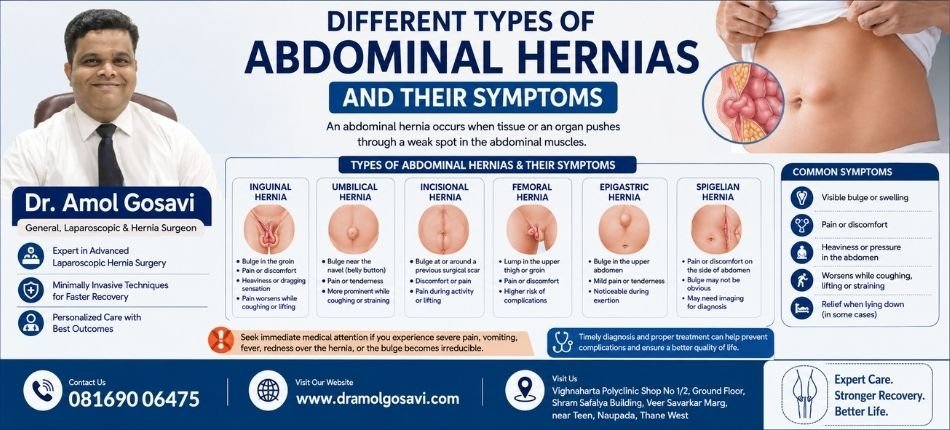
Different Types of Abdominal Hernias and Their Symptoms:- Dr. Amol Gosavi
Introduction
A hernia occurs when an internal organ or tissue pushes through a weakened area in the muscle or connective tissue that normally holds it in place. Hernias can develop in different areas of the abdomen and groin, and their symptoms may range from a small, painless bulge to significant discomfort or complications requiring urgent medical attention.
Understanding the types of abdominal hernias and their symptoms can help people recognize warning signs and seek appropriate medical evaluation. Some hernias may remain relatively stable for a period, while others can gradually increase in size or become painful.
In this guide, Dr. Amol Gosavi explains the common types of abdominal hernias, their symptoms, possible causes, and available treatment approaches.
What Is an Abdominal Hernia?
An abdominal hernia develops when tissue, often fatty tissue or part of the intestine, protrudes through a weak point in the abdominal wall.
The weakness may be present from birth or develop later because of factors that increase pressure on the abdominal wall. Previous surgery can also create an area of weakness where an incisional hernia may subsequently develop.
A visible or palpable bulge is a common symptom, but not every hernia produces obvious signs in its early stages.
What Are the Common Types of Abdominal Hernias?
Several types of hernias can affect the abdomen and groin. They are generally classified according to where they occur.
1. Inguinal Hernia
An inguinal hernia develops in the groin and is particularly common in men. It occurs when tissue protrudes through a weak area in the lower abdominal wall or inguinal canal.
The bulge may become more noticeable while standing, coughing, lifting something heavy, or straining.
Common symptoms can include a groin bulge, aching or discomfort, a feeling of heaviness, and pain that becomes worse with physical activity.
Some inguinal hernias cause minimal discomfort initially but may gradually become larger.
2. Umbilical Hernia
An umbilical hernia develops around the belly button or navel.
It occurs when tissue pushes through an opening or weakened area of the abdominal wall near the umbilicus. Although commonly associated with infants, umbilical hernias can also occur in adults.
Adults may notice a soft bulge around the belly button that becomes more prominent when coughing, straining, or increasing abdominal pressure.
Pain or tenderness may develop, particularly as the hernia becomes larger.
3. Incisional Hernia
An incisional hernia occurs at or near the site of a previous abdominal surgical incision.
Even after a surgical wound has healed, the abdominal wall at that location may remain weaker than surrounding tissue. Over time, tissue may protrude through this weakened area.
Symptoms can include a bulge around the previous surgical scar, discomfort, pain during physical activity, or increasing prominence while coughing or straining.
Incisional hernias can develop months or even years after the original operation.
4. Femoral Hernia
A femoral hernia develops in the upper thigh or groin region when tissue protrudes through the femoral canal.
Femoral hernias are less common than inguinal hernias but are clinically important because they can have a greater tendency to become trapped or strangulated.
A patient may notice a small lump in the upper inner thigh or groin, sometimes accompanied by discomfort.
Because complications can occur, suspected femoral hernias should be medically evaluated.
5. Epigastric Hernia
An epigastric hernia develops in the upper central abdomen, between the belly button and the lower part of the breastbone.
These hernias may contain fatty tissue protruding through a weakness in the abdominal wall.
Some epigastric hernias remain small and cause few symptoms, while others may cause tenderness or discomfort, particularly during activities that increase abdominal pressure.
6. Spigelian Hernia
A Spigelian hernia is less common and occurs through a weakness along the side of the abdominal wall.
Because it may develop between layers of abdominal muscles, the bulge can sometimes be less obvious than with other types of hernias.
Patients may instead experience localized abdominal discomfort or pain. Imaging may sometimes be required to confirm the diagnosis.
What Are the Common Symptoms of an Abdominal Hernia?
Symptoms depend on the type, size, and location of the hernia. Common signs may include a visible or palpable lump, pain or discomfort around the affected area, a feeling of pressure or heaviness, and discomfort while coughing, lifting, bending, or straining.
Some hernias become more noticeable while standing and may become less prominent when lying down.
However, the absence of severe pain does not necessarily mean a hernia should be ignored.
What Causes Abdominal Hernias?
Hernias generally involve a combination of weakness in the abdominal wall and pressure pushing against that weakened area.
Factors that may contribute include aging, previous abdominal surgery, heavy or repetitive lifting, chronic coughing, constipation and repeated straining, pregnancy, and increased abdominal pressure.
Some people may also have a naturally weaker abdominal wall.
Having one or more risk factors does not necessarily mean a person will develop a hernia.
When Can a Hernia Become an Emergency?
Most hernias do not present as immediate emergencies, but complications can occasionally occur.
A hernia may become incarcerated when the protruding tissue becomes trapped and cannot return to its normal position. If the blood supply to trapped tissue becomes compromised, it may develop into a strangulated hernia, which requires urgent medical treatment.
Seek immediate medical care for severe or rapidly worsening pain, vomiting, significant abdominal swelling, a painful or tender hernia that cannot be pushed back, or skin discoloration over the hernia.
How Are Abdominal Hernias Diagnosed?
Many hernias can be identified through medical history and physical examination.
The doctor may examine the area while the patient is standing, coughing, or straining because these actions can make a hernia more noticeable.
In cases where the diagnosis is uncertain or deeper structures need evaluation, imaging such as ultrasound, CT, or other investigations may be recommended.
Do All Abdominal Hernias Need Surgery?
Not every hernia requires immediate surgery. The decision depends on the type of hernia, symptoms, size, risk of complications, overall health, and individual circumstances.
Some minimally symptomatic hernias may be monitored in selected patients after medical assessment.
However, hernias generally do not close on their own in adults. Symptomatic, enlarging, or higher-risk hernias may require surgical repair.
Treatment Options for Abdominal Hernias
Surgery is the definitive treatment for many symptomatic abdominal wall hernias.
Depending on the type and complexity of the hernia, repair may be performed through open surgery or minimally invasive laparoscopic surgery.
In many adult hernia repairs, mesh may be used to reinforce the weakened abdominal wall. The choice of technique depends on the individual case and should be discussed with the surgeon.
Consult Dr. Amol Gosavi for Hernia Evaluation
If you notice an unexplained abdominal or groin bulge, persistent discomfort, or pain that increases with coughing, lifting, or physical activity, consider seeking medical evaluation.
Dr. Amol Gosavi provides consultation for patients with abdominal wall and groin hernias. Appropriate examination and investigations can help determine the type of hernia and whether observation or surgical treatment is suitable.
Conclusion
There are several types of abdominal hernias and their symptoms can vary according to the location and severity of the condition. Inguinal, umbilical, incisional, femoral, epigastric, and Spigelian hernias each occur in different areas of the abdominal or groin region.
Recognizing symptoms such as an unexplained bulge, pain, heaviness, or discomfort during physical activity can help patients seek timely evaluation.
If you suspect a hernia, consult Dr. Amol Gosavi for an appropriate diagnosis and individualized treatment recommendation.
Types of Abdominal Hernias and Their Symptoms Types of Abdominal Hernias and Their Symptoms Types of Abdominal Hernias and Their Symptoms Types of Abdominal Hernias and Their Symptoms Types of Abdominal Hernias and Their Symptoms Types of Abdominal Hernias and Their Symptoms Types of Abdominal Hernias and Their Symptoms Types of Abdominal Hernias and Their Symptoms Types of Abdominal Hernias and Their Symptoms Types of Abdominal Hernias and Their Symptoms Types of Abdominal Hernias and Their Symptoms
