
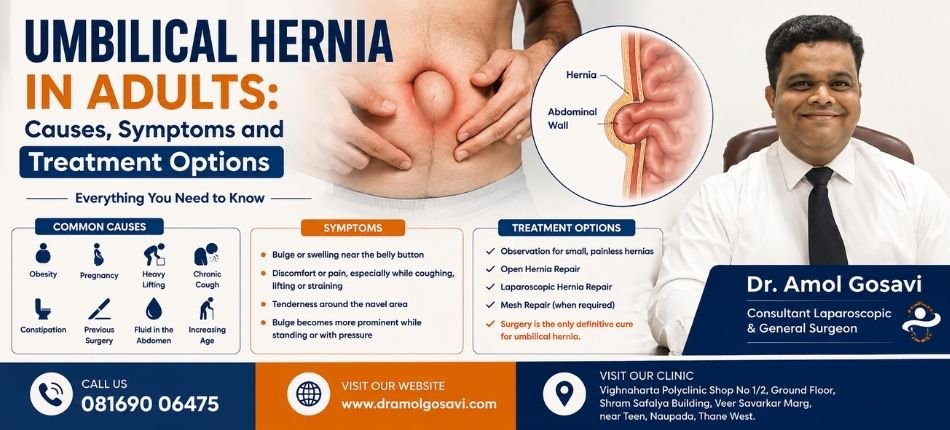
Umbilical Hernia in Adults: Causes, Symptoms and Treatment Options – Dr. Hitesh Kamble
Have you noticed a soft bulge or swelling around your belly button that becomes more noticeable when you cough, strain, exercise, or lift something heavy? This may be an umbilical hernia.
An umbilical hernia in adults develops when tissue, fat, or part of the intestine pushes through a weakened area of the abdominal wall near the navel. While umbilical hernias are commonly associated with babies and young children, they can also develop in adults.
Unlike many childhood umbilical hernias, which may close naturally, an adult umbilical hernia generally does not heal on its own. Some remain small and cause few symptoms, while others gradually enlarge or become painful.
Understanding the causes, symptoms, possible complications, and available treatment options can help patients seek appropriate medical care at the right time.
What Causes Umbilical Hernia in Adults?
The abdominal wall normally keeps internal tissues and organs securely in place. An umbilical hernia can develop when there is weakness around the navel combined with increased pressure inside the abdomen.
Several factors may contribute to this increased pressure.
1. Obesity or Excess Body Weight
Excess body weight can place additional pressure on the abdominal wall. Over time, this may contribute to weakness around the belly button and increase the likelihood of developing a hernia.
2. Pregnancy
Pregnancy stretches the abdominal wall and increases pressure inside the abdomen. The likelihood may be higher after multiple pregnancies.
A bulge around the navel that develops during or after pregnancy should be evaluated by a healthcare professional to determine its cause.
3. Heavy Lifting and Repeated Straining
Repeated heavy lifting, especially when accompanied by excessive straining, can increase intra-abdominal pressure.
People involved in physically demanding occupations should use appropriate lifting techniques and seek medical advice if they notice a new abdominal bulge.
4. Chronic Coughing
Persistent coughing repeatedly increases abdominal pressure. Chronic respiratory conditions or other causes of prolonged coughing can therefore contribute to the development or worsening of a hernia in susceptible individuals.
5. Chronic Constipation
Regular straining during bowel movements can increase abdominal pressure. Managing persistent constipation is therefore important for general health as well as reducing repeated abdominal strain.
6. Fluid Accumulation in the Abdomen
Conditions that cause significant fluid accumulation within the abdominal cavity can increase pressure on the abdominal wall and contribute to hernia formation.
Such cases require medical evaluation of both the hernia and the underlying condition.
7. Previous Abdominal Surgery
Some abdominal wall hernias occur around previous surgical incisions. Although these are usually classified as incisional hernias, the exact location of the weakness should be assessed by a surgeon to determine the type of hernia present.
What Are the Symptoms of an Umbilical Hernia in Adults?
The most recognizable symptom is a bulge or swelling near the belly button.
Other symptoms can include:
- A visible lump around the navel
- Discomfort around the belly button
- Pain while coughing or straining
- Pain during certain physical activities
- Tenderness around the bulge
- A bulge that becomes more prominent while standing or exerting pressure
Some small umbilical hernias may initially cause little or no pain.
However, absence of pain does not necessarily mean that the hernia should be ignored. A medical assessment can determine its size, characteristics, and appropriate management.
Can an Umbilical Hernia Get Bigger?
Yes. Some adult umbilical hernias can gradually increase in size.
Repeated pressure from lifting, coughing, straining, obesity, or other factors may contribute to enlargement. As the hernia becomes larger, discomfort and limitations during physical activities may also increase.
This is one reason why a persistent abdominal bulge should be evaluated rather than self-diagnosed.
Is Umbilical Hernia in Adults Dangerous?
Many umbilical hernias are not immediately dangerous, but complications can occur.
Two important complications are incarceration and strangulation.
Incarcerated Hernia
An incarcerated hernia occurs when tissue becomes trapped in the hernia and cannot readily return to the abdominal cavity.
Strangulated Hernia
Strangulation occurs when the blood supply to trapped tissue is compromised. This is a medical emergency because the affected tissue can become damaged.
Warning Signs That Need Urgent Medical Attention
Seek urgent medical care if an umbilical hernia suddenly becomes severely painful, firm, tender, or cannot be pushed back in. Redness or dark discoloration around the bulge, nausea, vomiting, or increasing abdominal swelling may indicate complications such as incarceration or strangulation. These symptoms require prompt medical evaluation.
Treatment Options for Umbilical Hernia in Adults
Treatment depends on the size of the hernia, symptoms, risk of complications, general health, and individual circumstances.
Observation
Selected small and minimally symptomatic hernias may sometimes be monitored after surgical assessment.
However, monitoring does not make the defect disappear. Patients should understand possible warning symptoms and attend follow-up appointments as advised.
How Is an Umbilical Hernia Diagnosed?
An umbilical hernia is usually diagnosed through a physical examination of the abdomen. The doctor may assess the bulge while you are standing, lying down, coughing, or gently straining. In some cases, an ultrasound or CT scan may be recommended to better evaluate the hernia and surrounding structures.
Open Umbilical Hernia Repair
In open repair, the surgeon accesses the hernia through an incision near the affected area. The protruding tissue is repositioned and the abdominal wall defect is repaired.
Depending on the size and characteristics of the defect, the surgeon may use sutures alone or reinforce the repair with surgical mesh.
Laparoscopic Hernia Repair
In selected patients, a laparoscopic or minimally invasive approach may be considered.
The operation is performed through small incisions using specialized instruments and a camera.
Whether open or laparoscopic repair is more appropriate depends on factors including hernia size, previous operations, patient health, anatomy, and surgeon assessment.
There is no single approach that is best for every patient.
Is Mesh Always Required?
No. The decision to use mesh depends on several factors, particularly the size and characteristics of the defect and the individual patient’s circumstances.
Mesh can reinforce the weakened abdominal wall and may reduce recurrence in appropriate cases. However, the decision should be made by the surgeon after evaluating potential benefits and risks.
Umbilical Hernia Surgery
Surgery is the definitive treatment for an adult umbilical hernia and may be recommended when the hernia is painful, enlarging, symptomatic, or at risk of complications. Depending on the individual case, the surgeon may perform an open or laparoscopic repair. Surgical mesh may be used when appropriate to reinforce the weakened abdominal wall.
Recovery After Umbilical Hernia Surgery
Recovery depends on the size of the hernia, surgical technique, overall health, and type of work performed by the patient. Gentle walking is often encouraged as advised, while strenuous exercise and heavy lifting may need to be temporarily restricted. Patients should follow their surgeon’s instructions regarding wound care, medicines, activity, and follow-up.
Can Umbilical Hernia Be Prevented?
Not every umbilical hernia can be prevented, but reducing unnecessary pressure on the abdominal wall may help lower the risk. Maintaining a healthy weight, managing constipation and persistent coughing, and using appropriate lifting techniques can be beneficial. After abdominal surgery, following recovery and activity instructions is also important.
Conclusion
Umbilical hernia in adults should not be ignored simply because the bulge is small or painless.
Adult hernias generally do not close naturally. While selected small hernias may be monitored under medical supervision, painful, enlarging, symptomatic, or complicated hernias may require surgical repair.
Both open and laparoscopic hernia surgery can be effective options when appropriately selected. The best treatment depends on the patient’s symptoms, anatomy, health, and characteristics of the hernia.
If you notice swelling or a bulge around your belly button, consult a qualified surgeon for an accurate diagnosis and individualized treatment recommendation.
Umbilical Hernia in Adults Umbilical Hernia in Adults Umbilical Hernia in Adults Umbilical Hernia in Adults Umbilical Hernia in Adults Umbilical Hernia in Adults Umbilical Hernia in Adults Umbilical Hernia in AdultsUmbilical Hernia in Adults Umbilical Hernia in Adults Umbilical Hernia in Adults
