
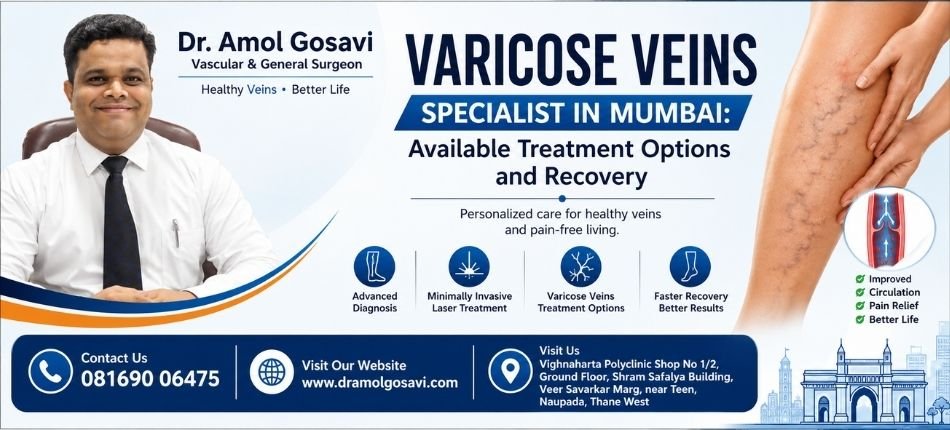
Varicose Veins Specialist in Mumbai: Available Treatment Options and Recovery – Dr. Amol Gosavi
Varicose veins are enlarged and twisted veins that commonly appear on the legs. For some people, they may initially be an aesthetic concern, while for others they can cause symptoms such as leg pain, heaviness, swelling, itching, cramps, or discomfort after standing for long periods.
If these symptoms persist or gradually become worse, consulting a Varicose Veins Specialist in Mumbai can help determine the underlying cause and severity of the condition. With modern diagnostic techniques and minimally invasive procedures, treatment can be planned according to the individual patient’s symptoms, vein anatomy, and overall health.
This guide explains the available treatment options for varicose veins, how specialists select an appropriate treatment, and what patients can generally expect during recovery.
What Are Varicose Veins?
Veins carry blood back toward the heart. The veins in the legs contain small valves that help prevent blood from flowing backward.
When these valves become weak or do not function properly, blood can accumulate inside the veins. Over time, increased pressure may cause the veins to become enlarged, twisted, and visible beneath the skin.
Varicose veins commonly develop in the legs because blood from the lower limbs has to travel upward against gravity.
Common Symptoms of Varicose Veins
Varicose veins may cause more than just visible blue or purple veins on the legs. Common symptoms include aching or throbbing pain, heaviness in the legs, swelling around the ankles, burning sensations, itching, muscle cramps, and tiredness in the legs, especially after standing or sitting for long periods. Some people may notice that their symptoms become more uncomfortable toward the end of the day. In more advanced cases, varicose veins may be associated with skin discoloration, dryness, inflammation, or changes around the lower legs and ankles. Persistent pain, swelling, skin changes, or worsening symptoms should be evaluated by a healthcare professional to determine whether an underlying venous circulation problem is present.
Why Do Varicose Veins Develop?
Varicose veins can develop due to several contributing factors. These may include genetics, age, prolonged standing or sitting, pregnancy, excess body weight, and reduced physical activity.
People whose work involves standing for extended periods may experience more noticeable symptoms if an underlying venous problem is already present.
A specialist assessment can help identify the extent of the condition and determine whether treatment is required.
When Should You See a Varicose Veins Specialist in Mumbai?
You may consider consulting a Varicose Veins Specialist in Mumbai when visible veins are accompanied by persistent pain, swelling, heaviness, itching, cramps, skin changes, or difficulty carrying out normal activities.
Medical evaluation is also important when symptoms are progressively worsening or when there are changes to the skin around the ankle or lower leg.
A consultation does not necessarily mean that a procedure will be required. The purpose is to determine the severity of the condition and identify an appropriate management plan.
How Does a Specialist Diagnose Varicose Veins?
Evaluation usually begins with a discussion of your symptoms, medical history, occupation, lifestyle, previous treatments, and family history.
The legs may then be examined for visible veins, swelling, skin changes, and other signs of venous disease.
Venous Doppler or Duplex Ultrasound
A venous Doppler or duplex ultrasound may be recommended in appropriate cases.
This non-invasive test helps evaluate blood flow through the veins and identify abnormal valve function or venous reflux.
Ultrasound findings can provide important information for deciding which veins require treatment and which treatment approach may be suitable.
Available Treatment Options for Varicose Veins
Treatment is not the same for every patient. The specialist may consider symptoms, ultrasound findings, vein size, location, overall health, and the presence of complications before recommending a treatment plan.
1. Lifestyle Modifications
Patients with mild symptoms may initially be advised to make certain lifestyle changes.
Regular walking, maintaining physical activity, managing body weight, avoiding unnecessary prolonged standing or sitting, and elevating the legs periodically may help manage symptoms.
However, lifestyle changes generally do not eliminate established varicose veins.
2. Compression Therapy
Compression stockings apply controlled pressure to the legs and may help support venous circulation and manage swelling or discomfort in selected patients.
The appropriate type and compression level should be determined based on medical advice.
Compression therapy may not be suitable for every patient, particularly when other vascular conditions are present.
3. Endovenous Laser Treatment
Endovenous laser treatment is a minimally invasive procedure used to treat certain veins affected by venous reflux.
During the procedure, a thin laser fibre is introduced into the affected vein under imaging guidance. Controlled laser energy is used to close the problematic vein.
Blood is then naturally redirected through healthier functioning veins.
The suitability of laser treatment depends on the patient’s vein anatomy and diagnostic findings.
4. Radiofrequency Ablation
Radiofrequency ablation is another minimally invasive treatment option.
Instead of laser energy, controlled radiofrequency-generated heat is used to close the affected vein.
The procedure is generally performed through a small access point, reducing the need for large surgical incisions.
5. Sclerotherapy
Sclerotherapy involves injecting a specialized solution into selected abnormal veins.
The solution causes the treated vein to close gradually. Sclerotherapy may be considered for certain smaller varicose veins or spider veins depending on the patient’s condition.
Some patients may require more than one treatment session.
6. Other Varicose Vein Procedures
Depending on the pattern and severity of the condition, a specialist may recommend additional minimally invasive or surgical procedures.
Some patients may also require a combination of techniques when different types of veins are involved.
How Does a Specialist Choose the Right Treatment?
A specialist chooses varicose veins treatment after considering the patient’s symptoms, severity of the condition, size and location of affected veins, overall health, and diagnostic findings. A venous Doppler or duplex ultrasound may be recommended to evaluate blood flow and identify whether the valves inside the veins are functioning properly. Based on these findings, the specialist may recommend conservative measures such as lifestyle changes or compression therapy, or procedures such as endovenous laser treatment, radiofrequency ablation, sclerotherapy, or another appropriate intervention. Since every patient’s vein pattern and symptoms can be different, treatment should be individualized rather than choosing a procedure based only on the appearance of visible veins.
Is Varicose Veins Treatment Painful?
The level of discomfort varies according to the procedure and individual patient.
Minimally invasive procedures are generally designed to reduce tissue disruption compared with traditional open surgery. Local anaesthesia or other pain-control measures may be used depending on the treatment.
Your specialist can explain what to expect before recommending a particular procedure.
Recovery After Varicose Veins Treatment
Recovery depends on the procedure performed and the severity of the condition.
Following certain minimally invasive procedures, patients may be encouraged to begin walking relatively early. However, activity recommendations differ between patients.
Temporary effects may include mild bruising, tenderness, tightness, or discomfort around the treated area.
These should be discussed with the treating doctor, particularly if symptoms are severe or unexpected.
How Soon Can You Return to Work?
Return-to-work time varies considerably.
A patient with a desk job may have different requirements from someone whose work involves prolonged standing, heavy lifting, or strenuous physical activity.
Your specialist will advise when you can safely resume normal work according to the procedure performed and your recovery progress.
Exercise After Varicose Veins Treatment
Walking may be encouraged following certain procedures because it supports normal circulation.
More strenuous activities such as running, heavy gym workouts, or weightlifting may need to be temporarily restricted.
Always follow the activity instructions provided by your treating specialist.
Can Varicose Veins Return?
Treatment can close or remove problematic veins, but some individuals may develop new varicose veins in other areas over time.
This is particularly possible in people with hereditary predisposition or ongoing risk factors.
Regular physical activity, healthy weight management, and appropriate follow-up may support long-term vein health.
Why Should You Avoid Delaying Evaluation?
Varicose veins do not progress in exactly the same way for every patient. However, persistent venous problems can sometimes lead to increasing swelling, skin pigmentation, inflammation, or ulcers in advanced cases.
Early evaluation allows the specialist to assess the condition before complications develop.
Importantly, early consultation does not automatically mean undergoing a procedure. Conservative management may be sufficient for some patients.
Choosing a Varicose Veins Specialist in Mumbai
When selecting a specialist, focus on proper diagnosis and individualized treatment planning.
During your consultation, consider asking:
- What is causing my varicose veins?
- Do I require a Doppler ultrasound?
- How severe is my condition?
- What treatment options are available?
- Why is a particular treatment recommended?
- What should I expect during recovery?
- When can I return to work and exercise?
- What follow-up will I need?
Having clear answers can help you make an informed decision about treatment.
Consult Dr. Amol Gosavi for Varicose Veins
Patients looking for a Varicose Veins Specialist in Mumbai can consult Dr. Amol Gosavi for evaluation and individualized treatment guidance.
A proper assessment helps identify the underlying venous problem and determine whether conservative management, minimally invasive treatment, or another approach may be appropriate.
Conclusion
Varicose veins should not always be considered merely a cosmetic concern. Persistent pain, swelling, heaviness, itching, cramps, or skin changes can indicate an underlying venous problem that deserves professional assessment.
Modern treatment options may include lifestyle measures, compression therapy, endovenous laser treatment, radiofrequency ablation, sclerotherapy, and other specialist-recommended procedures.
If you are searching for a Varicose Veins Specialist in Mumbai, begin with a proper evaluation. Understanding the cause and severity of the condition makes it easier to select an appropriate treatment and plan for a safe, comfortable recovery.
Varicose Veins Specialist in Mumbai Varicose Veins Specialist in Mumbai Varicose Veins Specialist in Mumbai Varicose Veins Specialist in Mumbai Varicose Veins Specialist in Mumbai Varicose Veins Specialist in Mumbai Varicose Veins Specialist in Mumbai Varicose Veins Specialist in Mumbai Varicose Veins Specialist in Mumbai Varicose Veins Specialist in Mumbai Varicose Veins Specialist in Mumbai
